
Author:
Green Steps
Short summary:
Standardized testing renders the best pedagogical intentions into a “null” curriculum. If we want to change the reality of schools, we need to change testing. This article explores what pedagogical experts say and how the Green Steps ARK responds.

ASSESSMENT SHAPES REALITY
One of the central insights from Nate Hagens podcast Reality Roundtable #25 with educators Dr. Theo Dawson and Dr. Zak Stein is that assessment systems are never neutral. They do not simply measure educational outcomes—they actively shape them. Schools, teachers, students and even parents adapt their behaviour to whatever is measured. Consequently, standardized testing has become one of the strongest forces determining what education actually looks like.
This creates what educational researchers often summarize as "what gets measured gets taught." Subjects and competencies that are easy to quantify become educational priorities, while equally important capacities that resist standardization gradually disappear from everyday schooling.
The result is a curricular reality characterized by:
• teaching towards predetermined answers rather than authentic inquiry;
• prioritizing factual recall over systems thinking;
• rewarding individual competition over collaboration;
• emphasizing academic performance while neglecting emotional and ecological development;
• reducing education to preparation for examinations instead of preparation for life.
As discussed in the podcast, these dynamics produce a powerful feedback loop: once tests become high-stakes, curricula narrow, instructional methods converge, and educational success becomes increasingly defined by performance on standardized measures rather than by human development.
THE LIMITS OF THE CURRENT ASSESSMENT PARADIGM
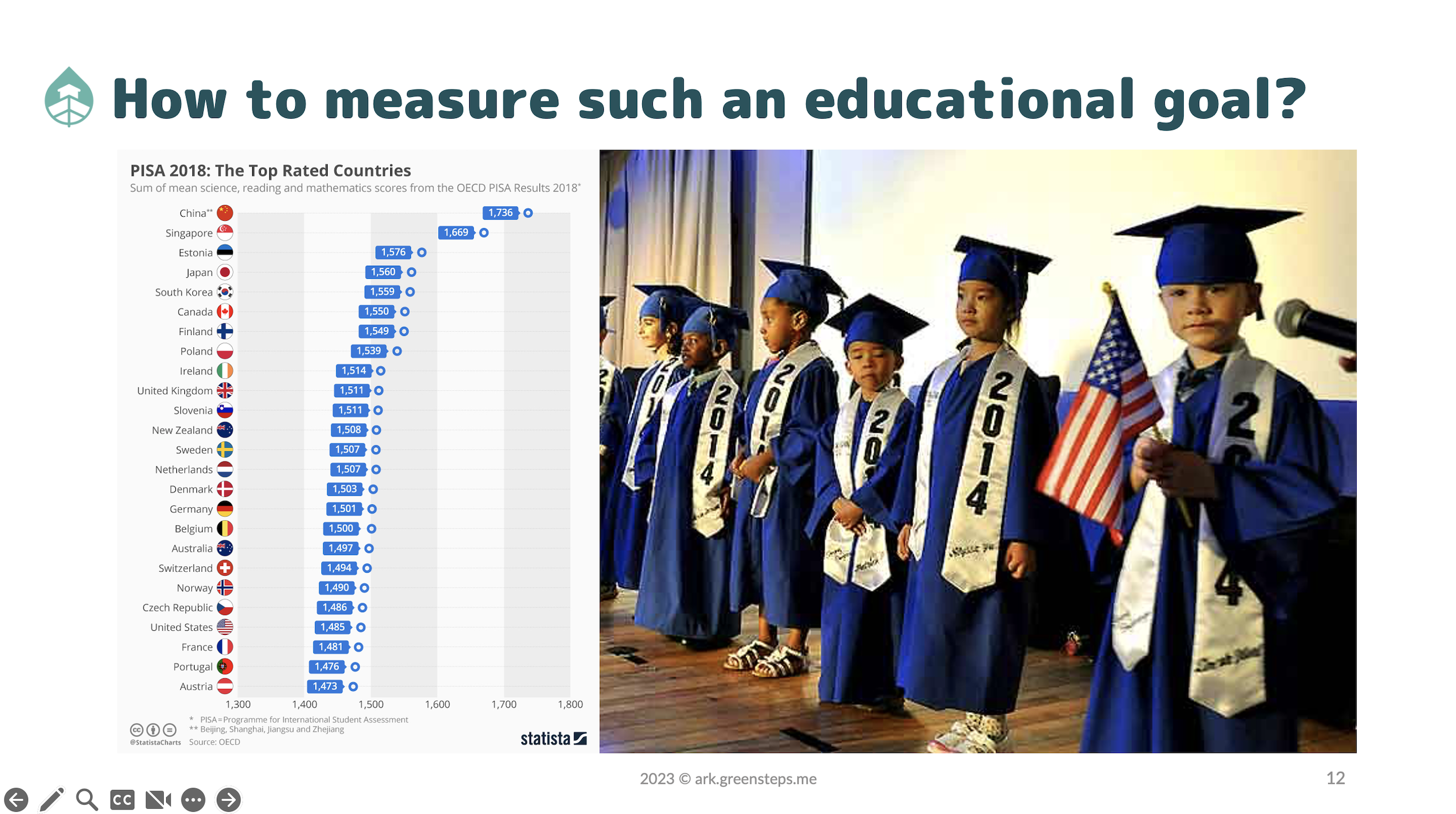
The Green Steps ARK starts from a remarkably similar diagnosis. Drawing on Daniel Goleman's Triple Focus, Peter Senge's systems thinking and Abraham Maslow's concept of human flourishing, the presentation argues that current educational systems measure only a fraction of what ultimately matters. The Green Steps ARK applies the Triple Focus as "a concept for post-PISA education", observing that existing educational strategies lack practical ways to make broader forms of learning visible through meaningful indicators and key performance measures.
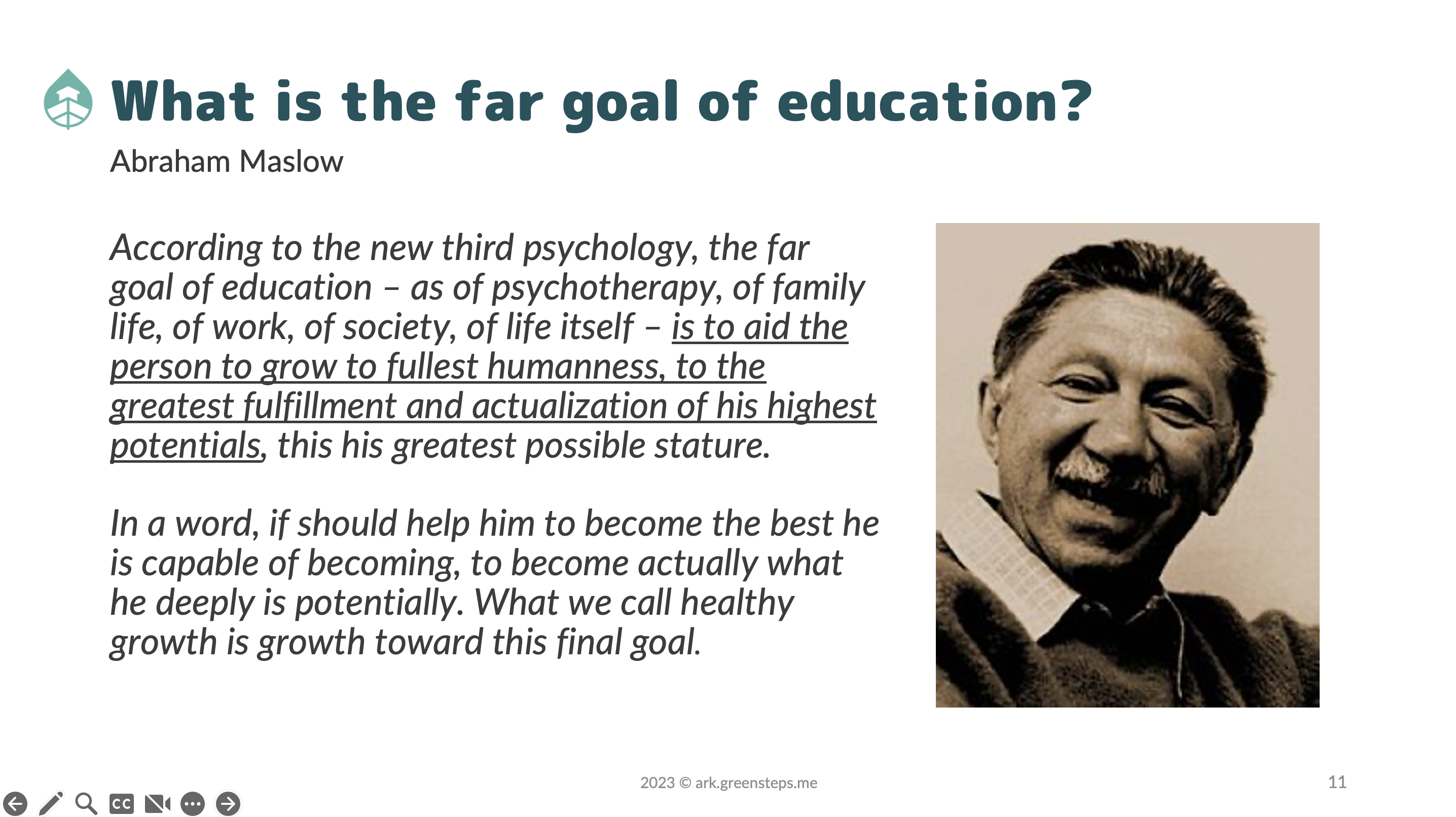
Maslow's question—"What is the far goal of education?"—is placed at the centre of the discussion. Rather than producing technically competent graduates alone, education should help people "grow to fullest humanness" and become the best version of themselves. This raises an unavoidable question: How do we measure educational success if the ultimate goal is human and to that extent social, economic and ecological flourishing rather than examination performance?
The Triple Focus as a New Assessment Framework
Inner focus attunes us to our intuitions, guiding values, and better decisions. Other focus smooths our connections to the people in our lives. And outer focus lets us navigate in the larger world. A leader tuned out of his internal world will be rudderless; one blind to the world of others will be clueless; those indifferent to the larger systems within which they operate will be blindsided. – Daniel Goleman & Peter Senge
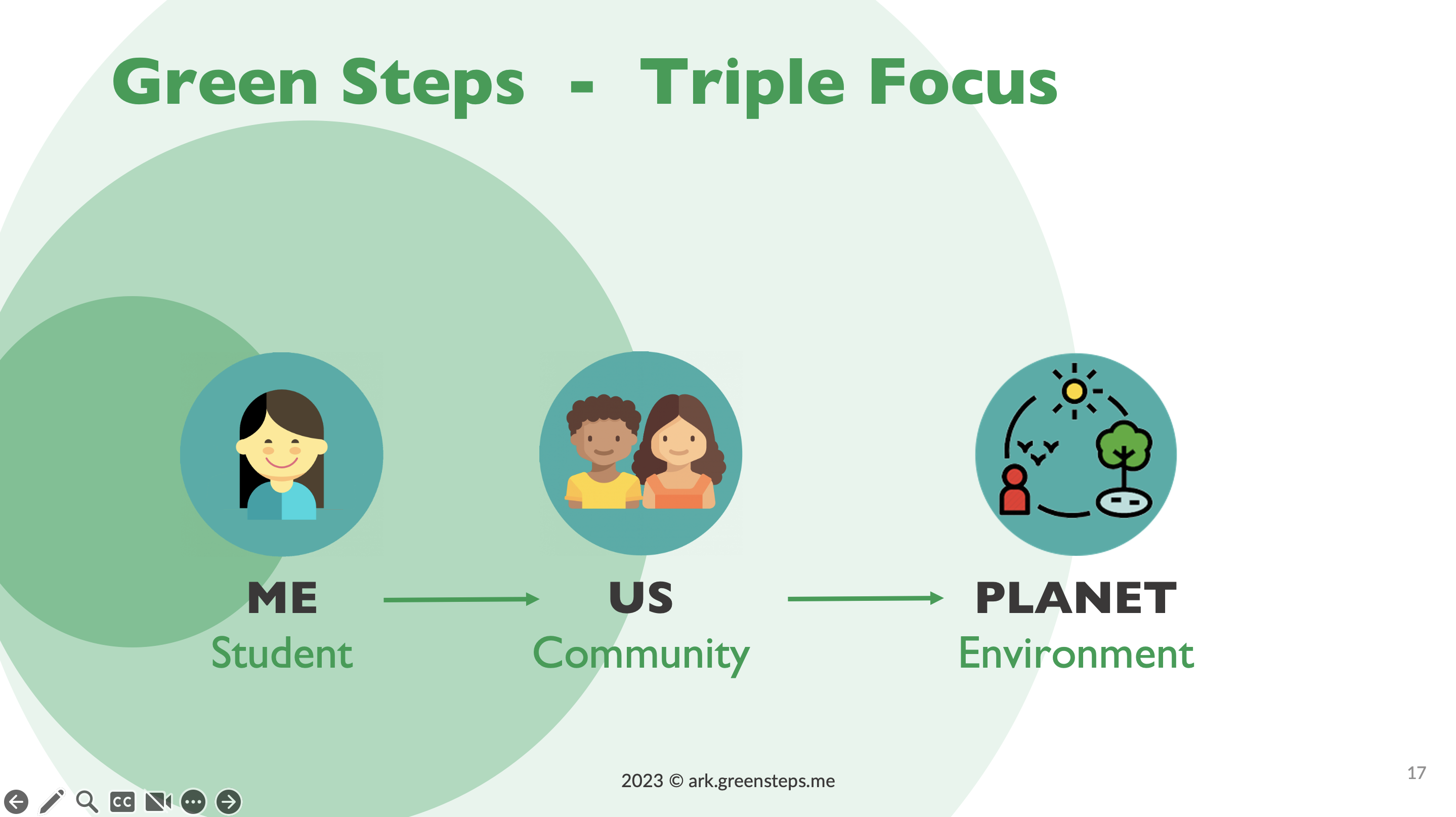
The Green Steps ARK answers this question by expanding what society chooses to assess. Instead of focusing exclusively on academic achievement, the ARK proposes the gamified visualization of three complementary dimensions of educational progress.
ME – Intrapersonal Development
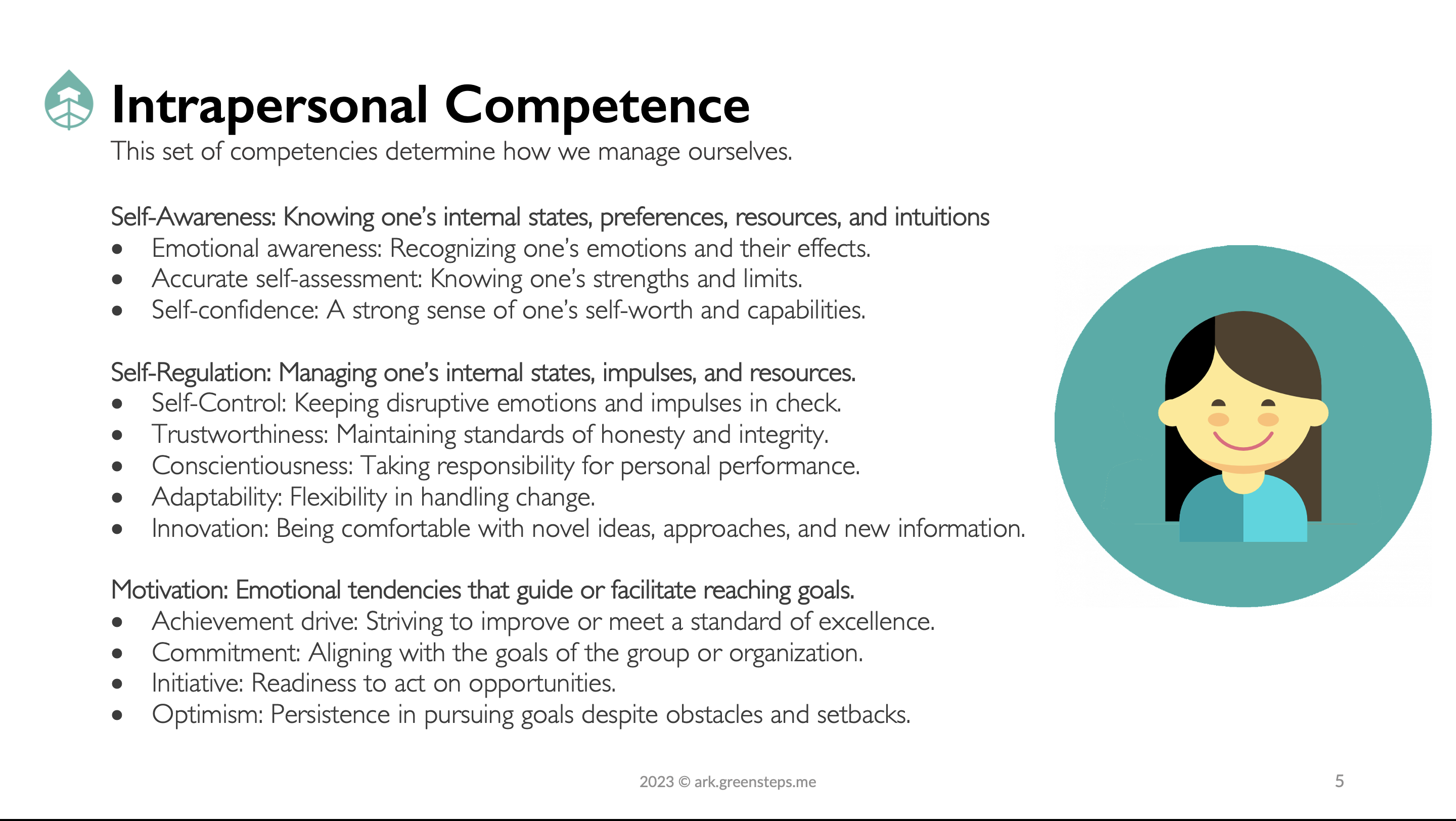
The first dimension measures the learner's relationship with themselves. Building on Goleman's work, this includes competencies such as: self-awareness, emotional regulation, motivation, adaptability, initiative, confidence, integrity. Rather than asking whether students can reproduce information, this dimension asks whether they are becoming increasingly capable of directing their own lives.
US – Interpersonal Development
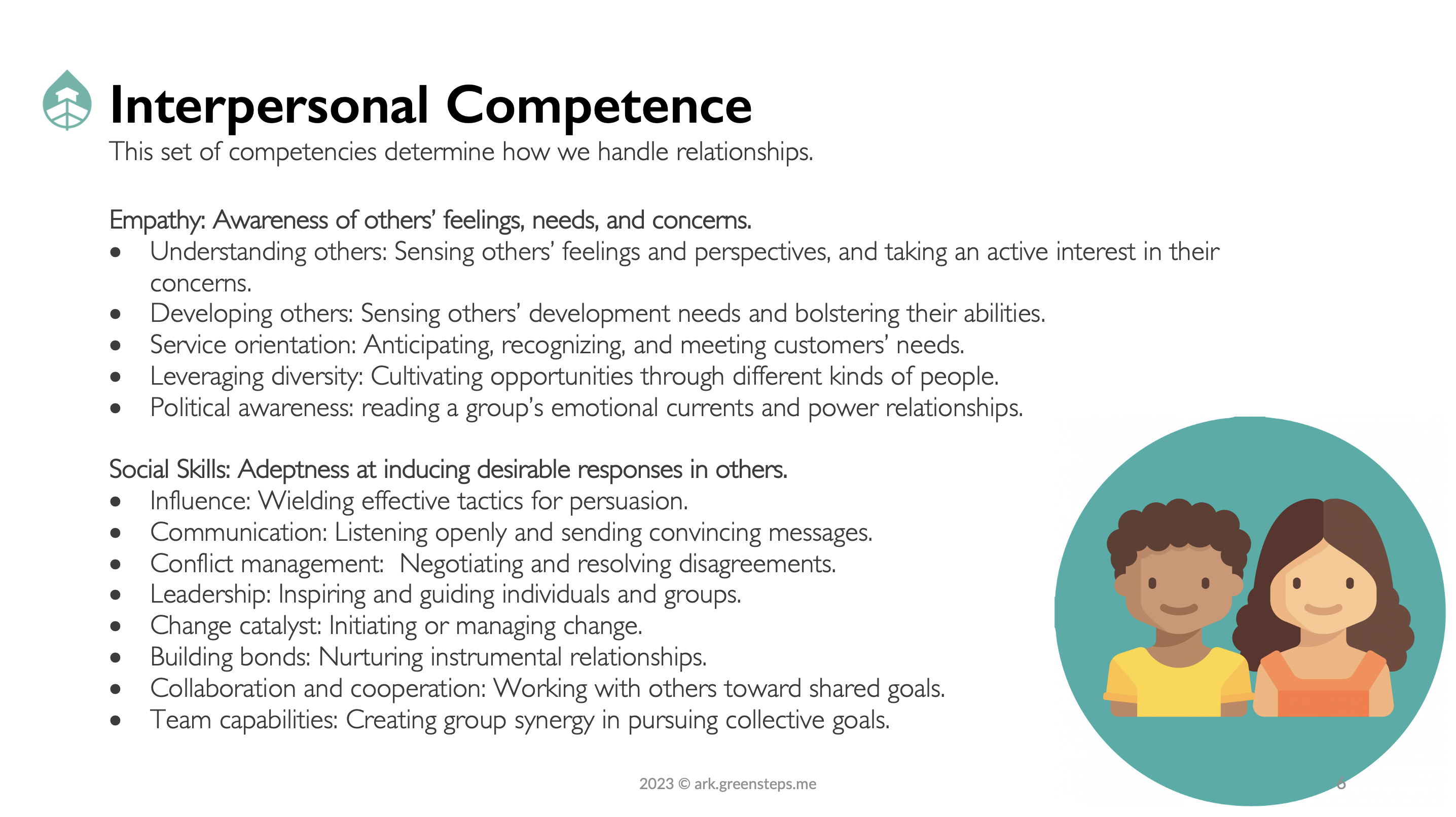
The second dimension focuses on relationships. Competencies include: empathy, communication, collaboration, conflict resolution, leadership, appreciation of diversity, teamwork. Educational success therefore includes the ability to strengthen communities rather than merely outperform peers.
PLANET – Environmental Competence
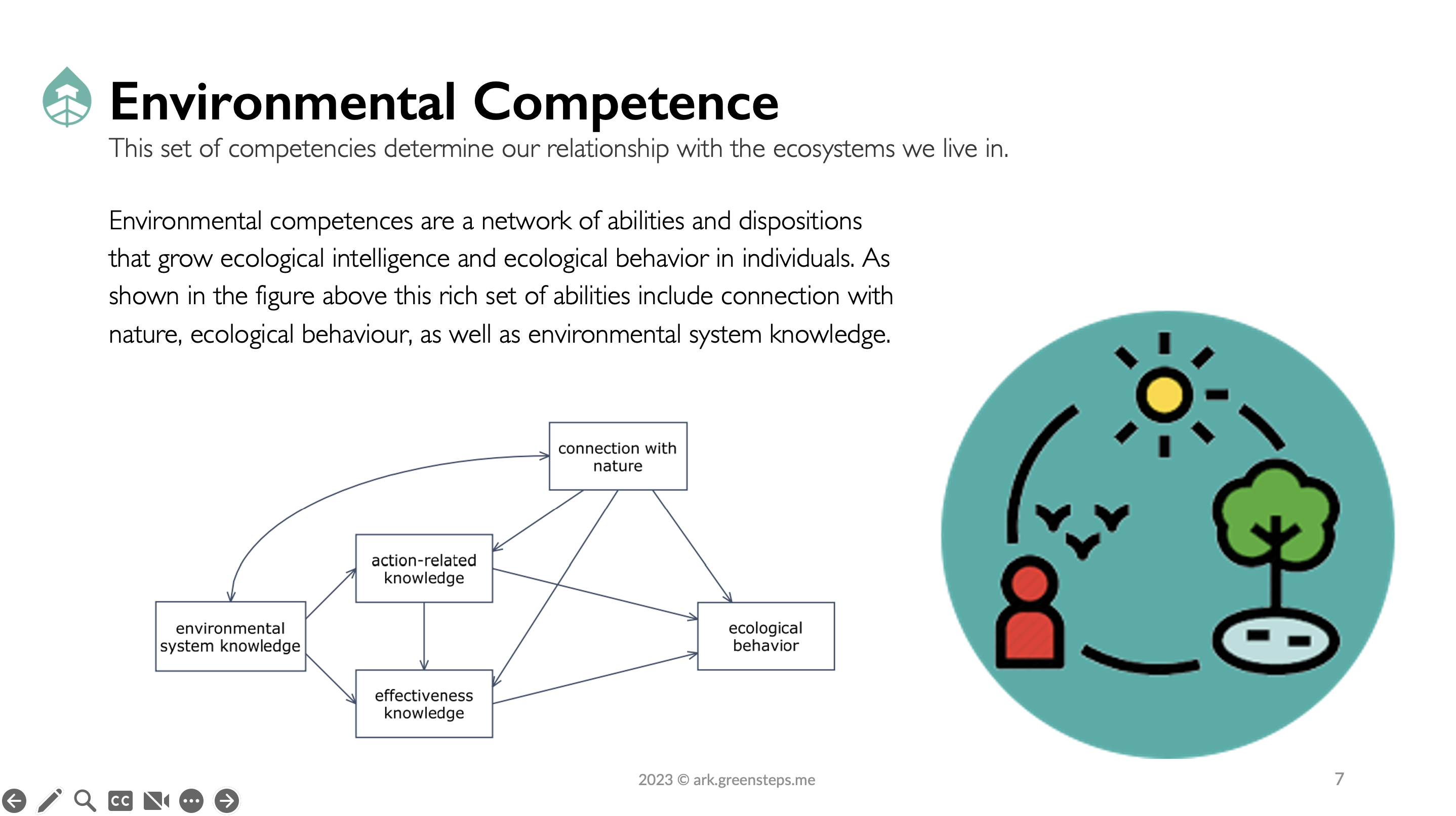
The third dimension represents the major extension of Goleman's original framework. Instead of "outer focus" referring primarily to systems thinking, the Green Steps ARK operationalises this dimension through the learner's relationship with the living world. Environmental competence includes: connection with nature, ecological behaviour, environmental systems understanding, stewardship of local ecosystems. The presentation summarises this as developing a meaningful relationship with the ecosystems in which we live.
Changing What Schools Optimise
The podcast argues that educational systems naturally optimise whatever indicators are attached to accountability. The Green Steps ARK therefore intervenes at precisely this leverage point. Rather than attempting to reform pedagogy alone, it seeks to redefine educational success through a broader set of measurable outcomes. Instead of asking only: "How much mathematics or language has the student mastered?" the ARK additionally asks:
• How has this student grown as a person?
• How has this student strengthened their community?
• How has this student contributed to the health of their local environment?
These three questions transform assessment from a narrow academic score into a multidimensional picture of human development.
From curriculum to contribution – from subjects to projects
The ARK's Triple Focus also changes the purpose of learning. Knowledge is no longer treated as an end in itself but as a resource for meaningful contribution. Students are encouraged not only to acquire knowledge but to activate it through practical action, restore ecological and social systems, and deepen understanding of themselves, their communities and their environment. This is reflected in the ARK's guiding framework:
• ME – developing the individual;
• US – strengthening communities;
• PLANET – restoring ecosystems.
As the presentation explains, strengthening individual self-awareness increases people's capacity to contribute to their communities while recognising the environment as humanity's common home. Conversely, ecological understanding and compassionate community practice reinforce personal growth, creating a mutually reinforcing developmental cycle.
CONCLUSIONS
Reality Roundtable #25 argues that the future of education depends less on inventing better teaching methods than on redesigning the incentive structures created by assessment. The Green Steps ARK addresses precisely this challenge. Instead of abandoning assessment, it proposes measuring a much richer conception of learning. By integrating intrapersonal competence (ME), interpersonal competence (US), and environmental competence (PLANET) into a common framework, the ARK seeks to shift educational optimisation away from standardized test performance and toward the cultivation of capable, compassionate and ecologically responsible citizens.
In this sense, the Triple Focus is not merely an educational philosophy as proposed by Goleman and Senge. On the Green Steps ARK it turns into a practical attempt to redesign the measurement system that ultimately shapes curricular reality and enables genuine rather than economic growth. If schools optimise what is measured, then expanding what we measure becomes one of the most powerful levers for transforming education itself.
Further reading:
• https://www.thegreatsimplification.com/episode/reality-roundtable-25
• https://www.goodreads.com/en/book/show/22840745
• https://forum.ark.greensteps.me/t/mapping-what-matters-from-lived-experience-to-metrics-of-bioregional-health/487
Interested to start a nature learning space in your town or school?
• https://ark.greensteps.me/page/create-community/
• https://ark.greensteps.me/page/commons-mentor/
Subscribe to newsletter:
• https://www.greensteps.me/membership.php
