
Author:
Adri Camacho Sanchez
Short summary:
Since 2019, Green Steps has used Curious Camps to explore place-based learning. The 2026 camp in St. Pölten used Joana Macy’s “Council of Beings” to guide a week of exploration, ending with masks representing different life forms. This review explores how Curious Camps can engage more teachers in place-based learning and shape indigenous identities.

TABLE OF CONTENTS
Overall Concept
Day 1 – Plants
Day 2 – Fish & Insects
Day 3 – Mammals
Day 4 – Birds
Day 5 – Amphibians & Dragonflies
Lesson-Based vs Project-Based Learning
OVERALL CONCEPT
curiosity | ˌkyo͝orēˈäsədē | noun (plural curiosities)
1 a strong desire to know or learn something: filled with curiosity, she peered through the window | curiosity got the better of me, so I called him.
2 a strange or unusual object or fact: he showed them some of the curiosities of the house.
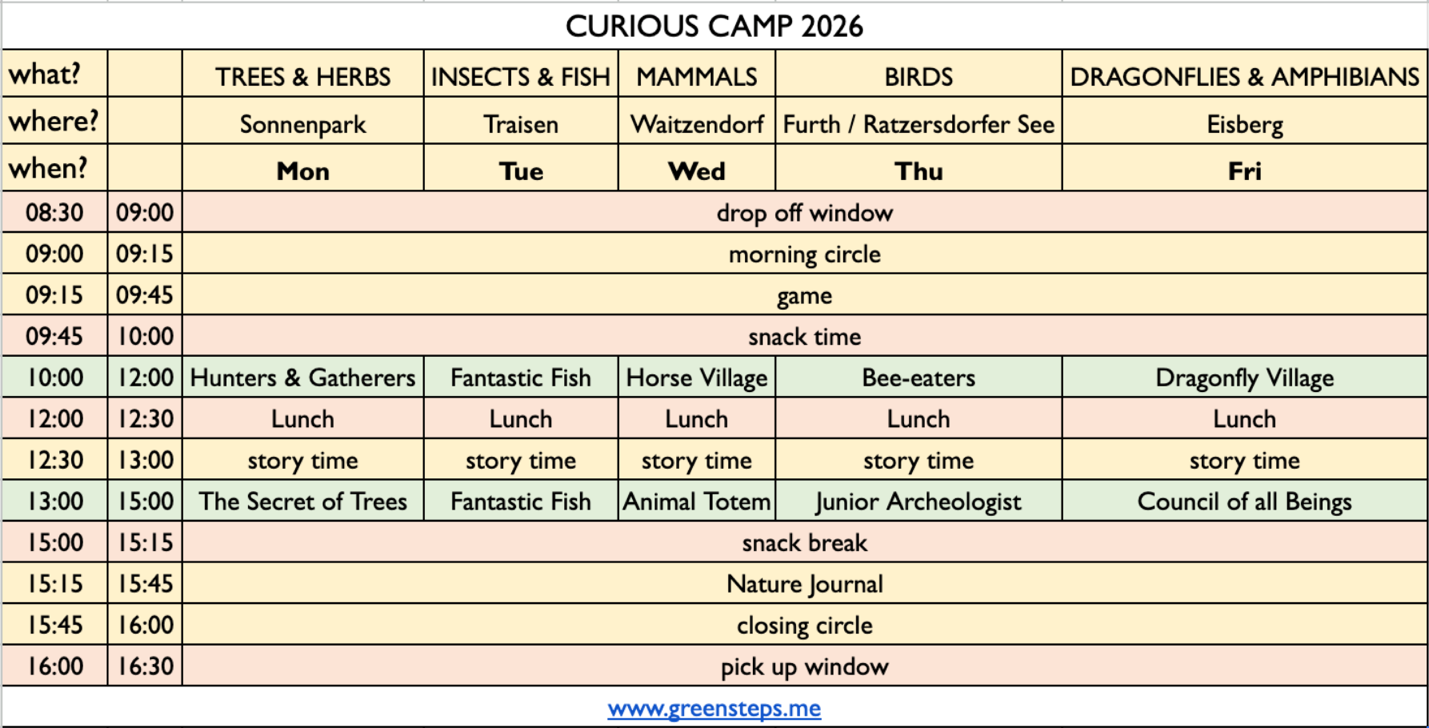
Curious Camps are a collection of place-based formats which aim at connecting with and finding one’s own role in the web of life. We understand our camps as indigenous learning experiences, which develop love, respect and stewardship. We have had participants as young as three years old and up to 12 and think that primary and lower secondary years are most suitable for exploring different spaces and life forms in this highly mobile format. This said, we believe that Curious Camps are a template for primary and lower secondary schools, which implement a full day curriculum.
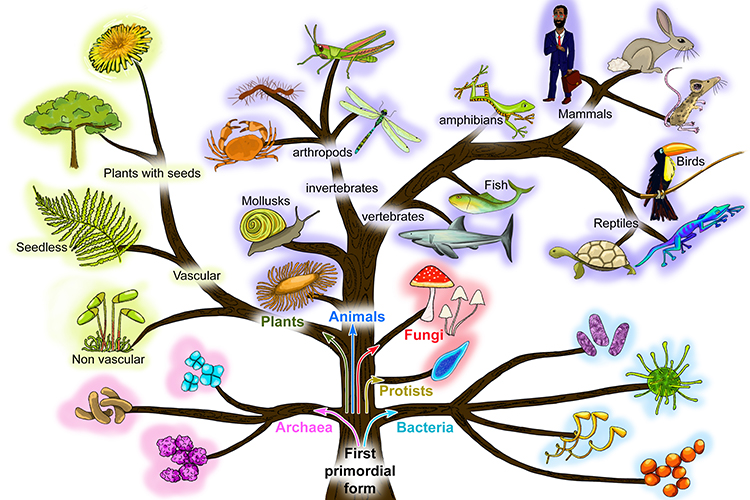
We seek to shape indigenous aka bioregional identities in our participants by reducing intellectual information and focusing on emotional experience. Every day starts by exploring our homebase, a 4ha natural park through playing hide & seek. One of the Camp Guides introduces in the morning circle a part of the tree of life. Participants get and share basic information about the daily life form focus, and we sing a related song before we head out to our learning destination. This year’s camp focused on trees, herbs, insects, fish, mammals, birds, dragonflies and amphibians.
We follow the three period lesson by recalling the life form introduced during the morning circle and experienced in the learning destination with a nature journal session which concludes the day before the children are being picked up by their parents. All observed species are also recorded on the Green Steps ARK, the digital backbone for place-based learning, which we develop for teachers to connect classrooms with their surroundings more easily.
The idea behind the platform is to turn the school neighborhood, municipality and region into a zoned learning space, which consists of experiential infrastructure that can be mapped and prepared for pedagogical exploration. There are many obstacles for teachers to move learning experiences from classrooms to the outdoors. The Green Steps ARK is conceived as a solution to overcome these obstacles. It saves time by offering a digital tool kit which supports teachers in the design of replicable outdoor classrooms.
.jpg)
Further reading:
• Curious Camp 2026
• Three Period Lesson & Nature Journal in a nutshell:
• Gever Tulley on project-based learning in the Tinkering School
• On Nature Alienation and Nature Alignment
• Scaling Place-Based Education Through a Networked Game
• Reconnecting to place for planetary health
Interested to start a nature learning space in your town or school?
• https://ark.greensteps.me/page/create-community/
• https://ark.greensteps.me/page/commons-mentor/
