
Author:
Bee-eater
Short summary:
In this essay, we explore how our relationship with nature and specific living environments can enable new forms of home, belonging and responsibility – beyond language, culture and origin.

Abstract
In this essay, which is based on a talk given on Sep 25th, 2026 in C-Space Berlin as the third instalment of the Heinrich Böll Foundation series “Inhabitable World”, we explore how our relationship with nature and specific living environments can enable new forms of home, belonging and responsibility – beyond language, culture and origin. I am deeply grateful to Katja Hellkötter for inviting me as a guest speaker and brainstorming with me on the direction of the talk. The result wouldn’t have been the seem without her guidance.
Watch the entire talk here, if you prefer listening over reading.
“Inhabitable Worlds|可栖之地’ | Bewohnbare Welten“ follows in the footsteps of humanist thought, as shaped by Heinrich Böll: the search for what unites us, for moral courage, empathy and social participation. Following the first two salons, which explored mother tongue and a voice in society (Dr Wang Ge) and the question of a good life (Dr Liya Yu), we now turn our attention to the natural foundations of our existence and the specific places we share with one another.
Our lives are always embedded in biological ecosystems. Particularly in a world shaped by migration and global mobility, people with different languages, histories and cultural experiences share the same places and living spaces. Perhaps this is where a common point of reference lies, beyond origin and cultural affiliation: the patch of earth we inhabit together.
What happens when a garden, a forest, a river or a neighborhood becomes the starting point for new forms of belonging, connection and responsibility? And how can bioregional identities and perspectives transform the way we live with one another and with our environment?
Part 1: Personal Journey
Watch: The Parrot Tree in Cenbo Village as Human-Scale Place at the Outskirts of Shanghai
When people ask me where I am from, I still tell them I am from that small village in suburban Shanghai, even though I was not born there and left it years ago. My emotional roots are deepest there—I wouldn't know what else to answer.
Why do I speak about this subject: "Bioregional Identities: A Post-Postmodern Approach to New Forms of Belonging"?
To provide context: back in 1994, I began studying law and psychology in Vienna. I initially developed a deep interest in European and international law, but quickly became disillusioned by the world of international diplomacy. I saw a self-absorbed international bureaucracy acting like a new aristocracy and wondered if we had truly made progress since the era of empires.
I decided to leave that path, dropping out of law school shortly before graduation to seek more meaningful ways for human organization. Later, through a research project on China's first national park in Yunnan with The Nature Conservancy, I studied how nature is governed, protected, and exploited.
Ultimately, it was living at a human-scale in Cenbu Village, where I resolved my internal conflict between being local and thinking global. What I am sharing today is the synthesis of that journey – not only across different places but also different disciplines.
Part 2: Philosophical Frameworks & The Evolution of World Orders
Modern, Postmodern, and Post-Postmodern Thought
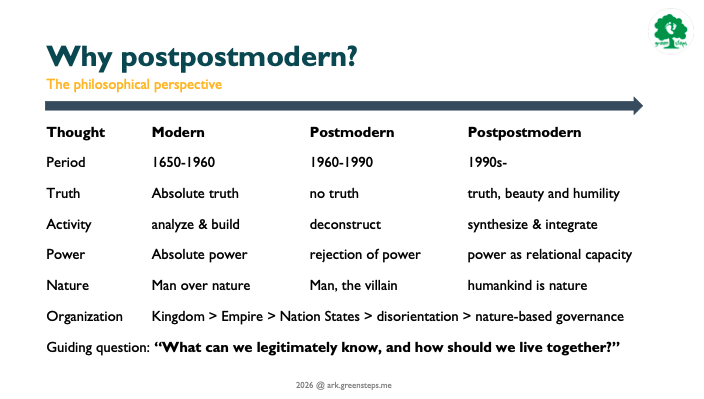
Philosophers and epistemologists concern themselves with knowledge, consciousness, and three overlapping periods of thought defined by a single guiding question: "What can we legitimately know, and how should we live together?"
• Modern Thought: Accepted absolute truth, centralized authority, and human dominance over nature.
• Postmodern Thought: Questioned absolute truth and power, dismantling constructs and viewing human dominance as destructive.
• Post-Postmodern Thought: Emerging since the 1990s, this perspective stems from the realization that neither modern dogmatism nor postmodern
deconstruction provides a satisfying answer to how we should live together constructively.
Corresponding Models of Governance
These philosophical eras align directly with human organizational structures:
1. Empires & Monarchies: Dominant during the pre-modern and modern eras.
2. Nation-States: The Congress of Vienna (1815), following the Napoleonic Wars, established the nation-state as the foundational unit of world order to preserve peace.
3. Disorientation of the Postmodern Era: World Wars I & II, alongside globalized trade, eroded confidence in static national borders, leaving us with a fragmented global framework.
Some politicians think nowadays regressively, as psychologists would say, and instead of growing up and evolving into something better, they prefer to make obsolete models of governance great again. Other politicians and their national subjects have not yet gone through the phase of postmodern thought and have not yet started to question absolute truth and power. They still have to experience the pain these stages of collective human development have brought upon other parts of the world already.
Part 3: Anthropological & Psychological Perspectives
The Four Realms of Anthropology
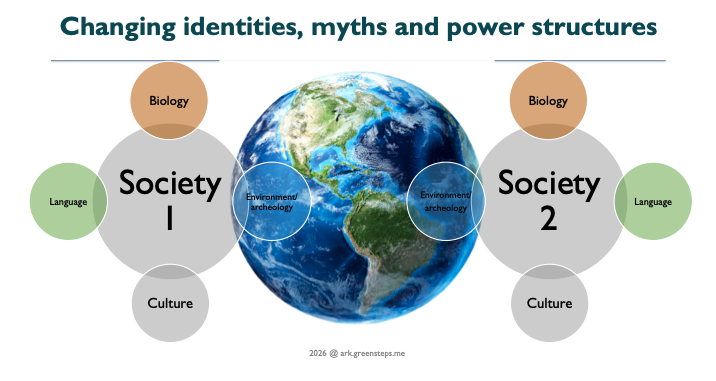
Anthropology—the study of humankind—can guide our search for new organizational structures. It encompasses four scientific disciplines which focus on certain aspects of human nature:
• Archaeology: is concerned with the built environment.
• Biology: analyzes the non-human organisms we interact with.
• Linguistics: looks at the languages used to communicate.
• Cultural Studies: try to understand behavioral patterns developed within human groups.
Historically, human societies lived distinctly separated lives across these four realms. Today, climate change and international trade show that we live in a single interconnected ecosystem—a shared "human hive".
The Overview Effect and Ecological Self
Astronauts experience a cognitive shift called the Overview Effect upon viewing Earth from orbit—perceiving it as a fragile, boundaryless, shared home. But how do the billions of people on Earth acquire this shift without going to space?
The good news is, that not all humans need to go into outer orbit to undergo a cognitive shift. Many of us have had this awareness of deep connection with nature at different levels and many more seem to develop such connectedness.
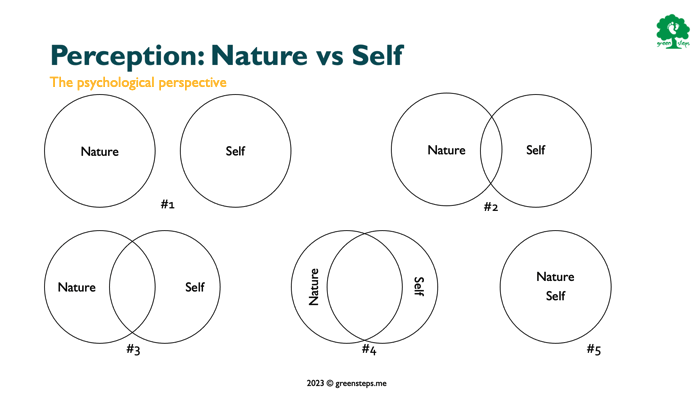
Ecopsychology explores how individual self-identity overlaps with nature. We must shift from complete alienation (viewing humans as separate from nature) to recognizing our deep ecological interconnectedness.
Part 4: The Scientific Foundation - Biogeography
The Arbitrary Construct of Nation-States
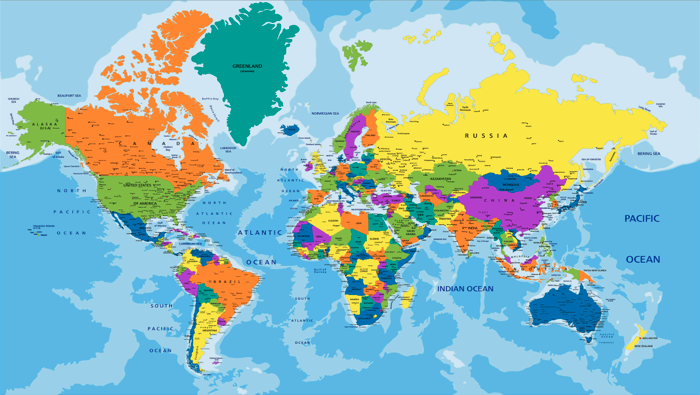
When meeting someone at an airport and asking, "Where are you from?", people instinctively map their answer to political borders. Yet, political world maps are only about 200 years old—a brief anomaly in our 100,000-year history as a species.
Nation-states create constructed identities that foster nationalism—often exploited to make citizens proud of things they didn't do or hate people they've never met. Climate change, biodiversity loss, and ecological crises do not respect political borders; addressing them requires a scientific, nature-based mapping system.
The recently deceased author of Persepolis, Marjane Satrapi described the conflict between governments and their subjects brilliantly in only a few lines, yet most right wing voters don’t understand that they have fallen prey to the interests of power elites.
„If I have one message to give to the secular American people, it’s that the world is not divided into countries. The world is not divided between East and West. You are American, I am Iranian, we don’t know each other, but we talk together and we understand each other perfectly. The difference between you and your government is much bigger than the difference between you and me. And the difference between me and my government is much bigger than the difference between me and you. And our governments are very much the same."
The Ecoregion Map
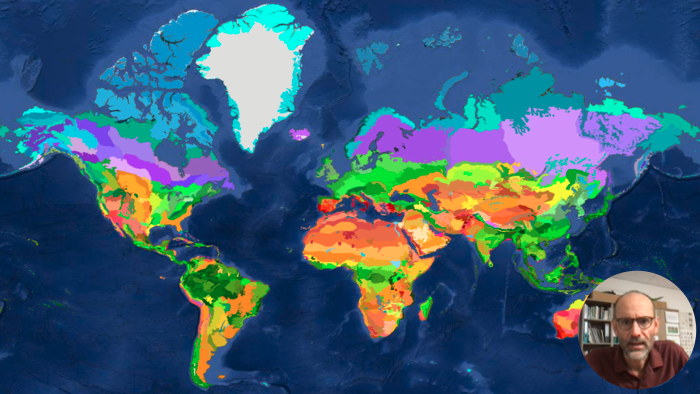
In 2017, conservation scientist David Olson and a team of researchers published a natural map dividing Earth’s land surface into 844 Ecoregions. With a median size roughly equivalent to Switzerland or Zhejiang Province, ecoregions provide a much higher-resolution, science-based structure than the world's 200+ nation-states.
Core Terminology (Bioregional Framework)
• Realms (14 Divisions): Broad land areas defined by shared evolutionary history and tectonic origins (e.g., the Palearctic realm covering Europe and northern Asia).
• Biomes (27 Zones): Broad plant/animal communities adapted to specific climate conditions across continents (e.g., temperate broadleaf forests).
• Bioregions (185 Geographic Units): Geographic spaces defined by unified ecological systems, watersheds, terrain, and soil characteristics.
• Bioregionalism: The cultural application of a bioregion, emphasizing local human populations, indigenous knowledge, and contextual solutions.
• Ecoregions (844 Subdivisions): High-resolution units within bioregions reflecting precise ecological realities.
Part 5: Practical Applications & Bioregional Identity
Practical Uses of Ecoregion Frameworks
1. Biodiversity Conservation: Identifying critical hotspots to protect species.
2. Regenerative Economics: Aligning local production, agriculture, and resource use with regional ecological boundaries.
3. Conflict Mitigation: Avoiding land and resource wars caused by ignoring physical watersheds and bioregional realities.
4. Place-Based Education & Health: Rooting learning in immediate local ecosystems.
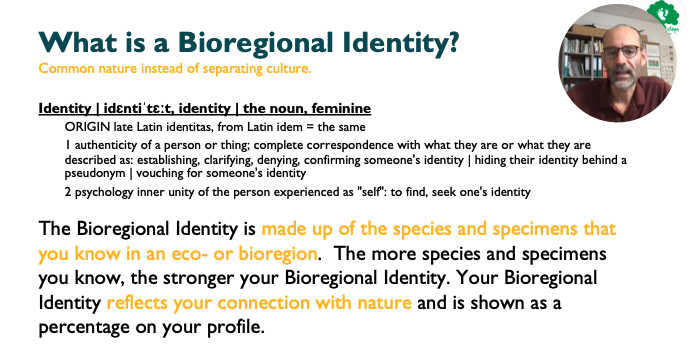
Defining a Bioregional Identity
Indigenous societies possessed an inherent bioregional identity—their survival depended on knowing local plants, animals, weather, and seasonal cycles. Today, bioregional identity offers a common, nature-grounded foundation that connects diverse human populations regardless of cultural origin. In cosmopolitan cities like Berlin or Vienna, a bioregional identity anchors immigrants and locals alike in the shared stewardship of their local environment.
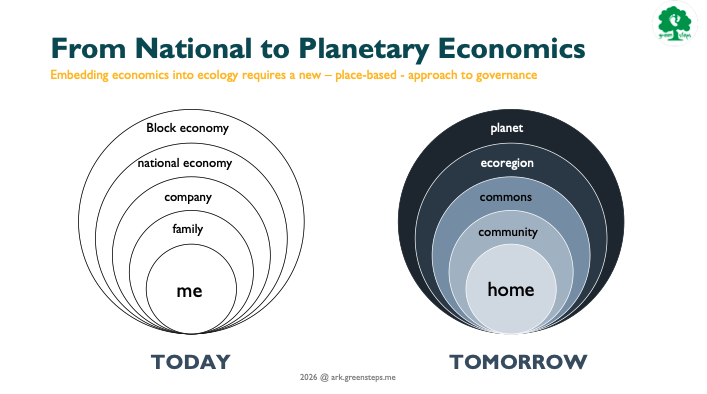
Nested Layers of Identity
Rather than replacing existing identities entirely, bioregionalism introduces a nested model of belonging:
Part 6: Evolutionary Scale & Present Geopolitics
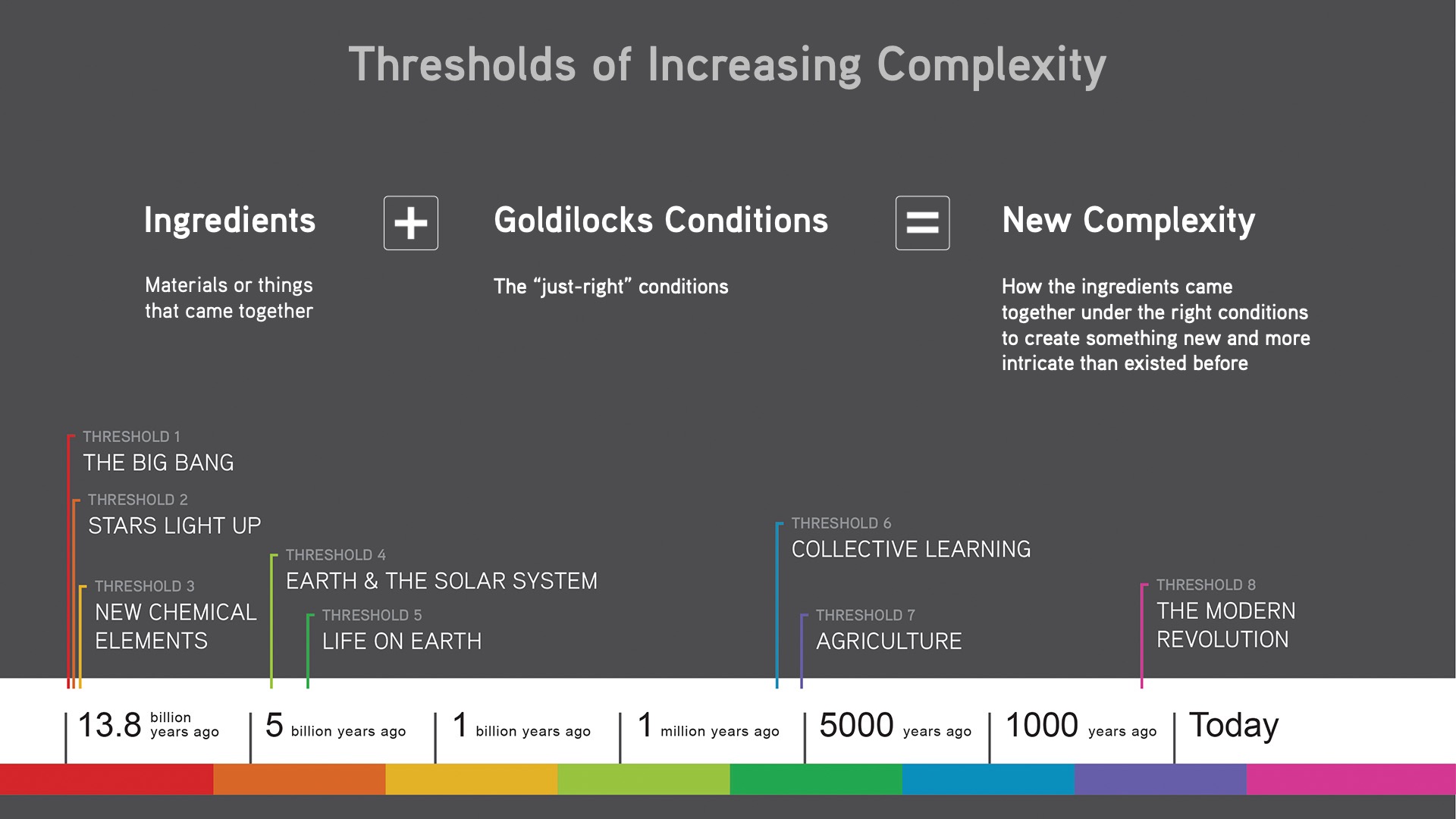
Big History and the 9th Complexity Threshold
In Big History, human evolution is framed through eight major complexity thresholds:
1. The Big Bang
2. Creation of Stars
3. New Chemical Elements
4. Earth & Solar System
5. Emergence of Life
6. Collective Learning
7. Agriculture
8. The Modern / Industrial Revolution
The Ninth Complexity Threshold may well be the shift from viewing ourselves as isolated individuals or competing nation-states to acting as a superorganism—a collective human hive embedded harmoniously within Earth's biosphere.
Shifting Tectonics in Modern Governance
Recent geopolitical shifts demonstrate that the traditional nation-state model is weakening under dual pressures:
• Pressure from Above/Beside: Quasi-sovereign corporate and tech monopolies outmaneuvering traditional state power and a new form of state capitalism practiced in China challenges existing capitalist governance.
• Pressure from Below/Outside: Global ecological crises requiring radical, cross-border interdependence rather than isolated national sovereignty.
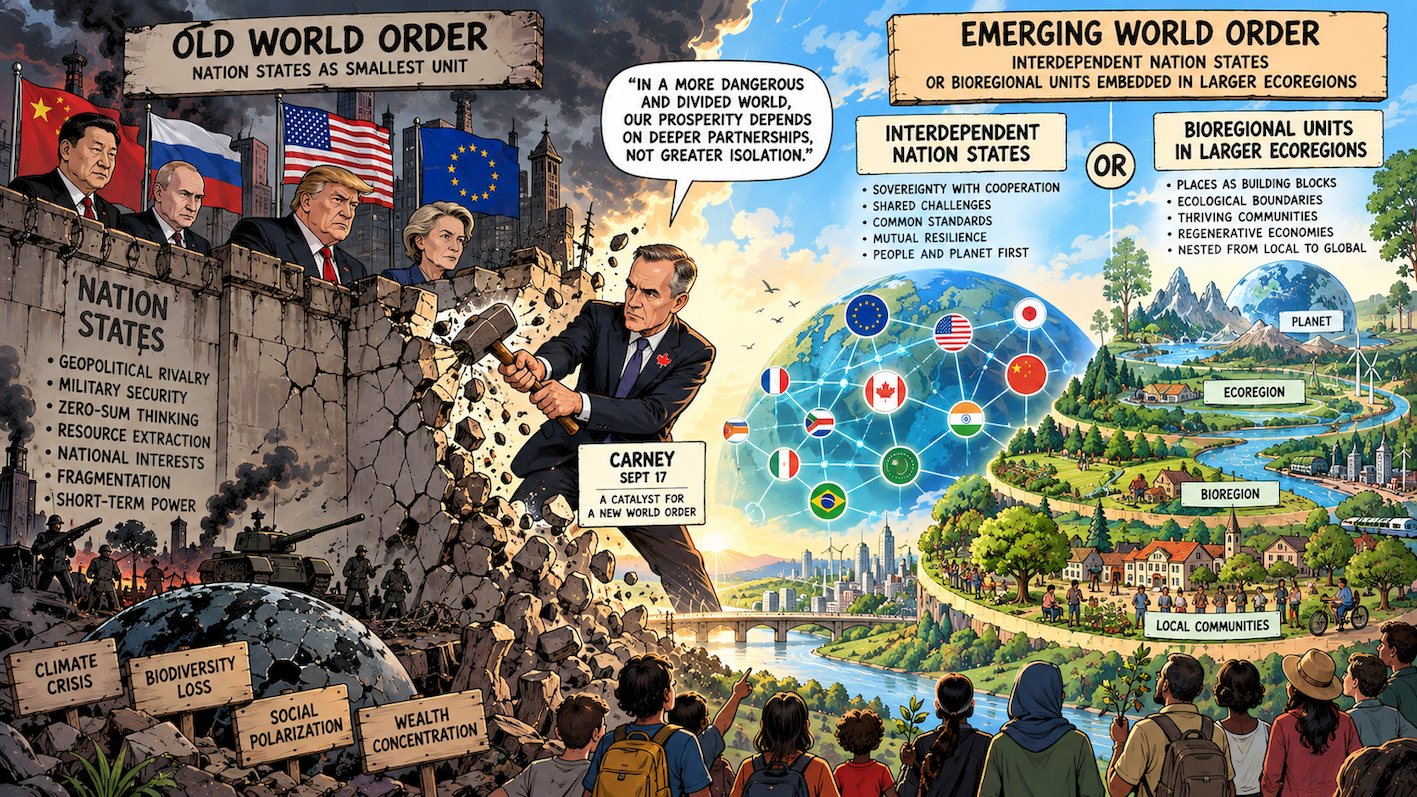
As external pressures intensify, political entities are forced into new forms of cooperation. Only recently, on Sep 17th, something interesting happened in the EU parliament. Canadian prime minister Marc Carney spoke upon Ursula van der Leyens invitation to the EU delegates about a closer relationship between Canada and the EU. His speech moved on the surface through three levels:
• Immediate geopolitics: Canada needs to reduce vulnerability to U.S. economic coercion.
• Institutional power: democratic governments need sufficient collective capacity to resist states and corporations that can exercise quasi-sovereign power.
• A new model of the democratic West: sovereignty through interdependence among democracies, rather than sovereignty through national self-sufficiency or dependence on a hegemon.
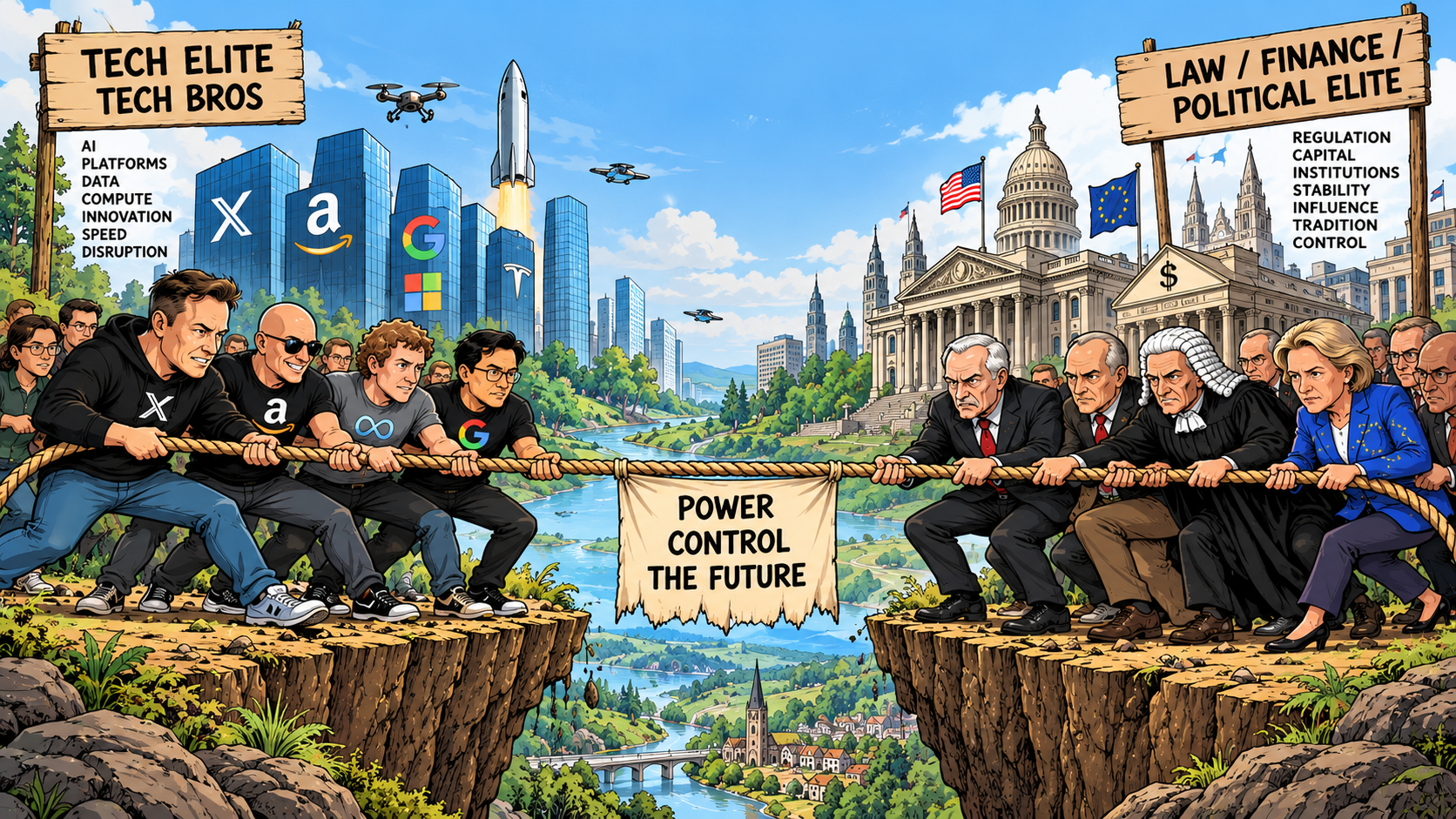
Beneath the surface, Mark Carney’s speech reveals a power struggle between the law-finance elite and the tech elite. Carney, a former high-end banker, argues that nation states are underminded in their souvereignty by tech corporations which threaten democracy. With some introspection, he could have added that his own class does the same.
And, similar to Michael Gorbachev who initiated the dissolution of the Soviet Republics, Carey initiates the dissolution of the current world order in which the nation state is the smallest unit. He explicietly says that the unit of power in the 21st century is no longer simply the nation-state and thereby shakes the foundation of international law which is in place since the Viennese Congress of 1815. Carney envisions a network of interdepent nations states with law and finance elites still in power, but maybe we are whitnessing the emergence of something completely different, something which is more in line with natural essence of our home planet.
Part 7: Conclusion & The Metaphor of the Lichen
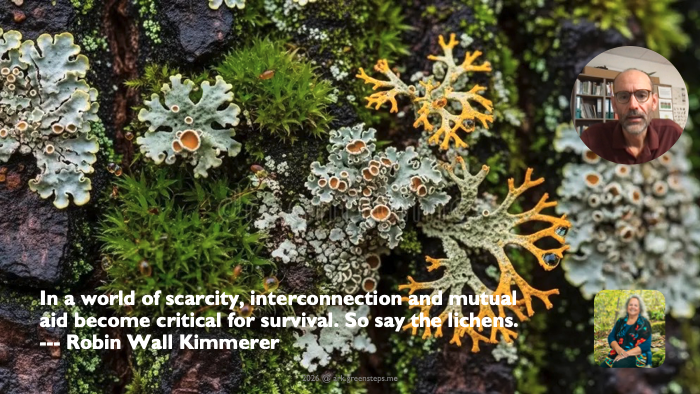
To illustrate how humanity can transition toward reciprocity under stress, Robin Wall Kimmerer's description of lichens in Braiding Sweetgrass offers a compelling ecological parallel:
“Scientists are interested in how the marriage of alga and fungus occurs and so they’ve tried to identify the factors that induce two species to live as one. But when researchers put the two together in the laboratory and provide them with ideal conditions for both alga and fungus, they gave each other the cold shoulder and proceeded to live separate lives, in the same culture dish, like the most platonic of roommates. The scientists were puzzled and began to tinker with the habitat, altering one factor and then another, but still no lichen. It was only when they severely curtailed the resources, when they created harsh and stressful conditions, that the two would turn toward each other and begin to cooperate. Only with severe need did the hyphae curl around the alga; only when the alga was stressed did it welcome the advances. When times are easy and there’s plenty to go around, individual species can go it alone. But when conditions are harsh and life is tenuous, it takes a team sworn to reciprocity to keep life going forward. In a world of scarcity, interconnection and mutual aid become critical for survival. So say the lichens.”
When conditions are easy, individual actors go it alone. But in times of severe systemic stress, mutual aid, reciprocity, and deep interconnection become the primary strategy for survival—for lichens, and for human society alike.
Further reading:
• Knut Wimberger, Bioregional Identities: https://www.youtube.com/watch?v=O4zcC9cMFHc&t=8s
• Green Steps Ecoregion Mentor training – join us or facilitate yourself: https://ark.greensteps.me/course/ecoregion-mentor-training-449b7
• Mark Carney addressing the EU parliament: https://www.youtube.com/live/T8lUxaXsDFk?is=Ik2VSwWApBMU9-Y0
• David Christian, Big History: https://www.bighistoryproject.com/
• Henry Kissinger, On World Order: https://www.darkmatteressay.org/blog/book-review-world-order-by-henry-kissinger
• Daniel Wahl, Reconnecting to place for planetary health: https://www.youtube.com/watch?v=L3zTAv-JWi0&t=1870s
Subscribe to newsletter: https://www.greensteps.me/membership.php
